Embarkation is a timed handoff
On a turnaround day a large ship may disembark several thousand guests in the morning and embark a similar number by mid-afternoon. Terminals such as Southampton, PortMiami, Barcelona and Civitavecchia often handle more than one ship at once. Each guest passes through a sequence of steps: arrival by car, coach or rail; baggage drop; security screening under the ISPS Code; document and health checks; and boarding over a gangway. Each step has finite throughput. Queues form wherever the arrival curve outruns the capacity of the next step.
Arrival time slots, now standard across most major lines, are the main lever. Their usefulness depends on how closely guests follow them, and on whether the morning's disembarkation actually finishes on time. A late inbound arrival compresses the whole day.
What passenger flow models read
- Booking data: party sizes, cabin categories, chosen arrival slots and flight details where guests provide them.
- Terminal layouts: check-in desks, screening lanes, gangways and waiting-area capacity.
- Historical patterns: how actual arrivals differed from booked slots on comparable days.
- Transport links: coach transfers, rail timetables and road distance to airports.
- Accessibility requirements: wheelchair assistance, mobility devices and medical equipment notified in advance.
With these inputs a model can forecast queue lengths by hour, suggest how many desks to open and when, and propose slot adjustments before guests travel. It is a planning aid, not a crowd-control system.
| Handoff | Capacity limit | Schedule dependency | Human owner |
|---|---|---|---|
| Kerb to check-in | Desks, staff, slots | Disembarkation finish time | Terminal operator |
| Screening to gangway | Lanes, gangways | All-aboard time | Ship security officer |
| Ship to tender | Seats per run, sea state | Arrival and anchoring time | Deck officers |
| Pier to excursion | Coaches, guides | Clearance time | Shore excursions team |
| Ship to airport | Transfers, customs lanes | Flight departures | Guest services, port agent |
Tender ports and shore excursions
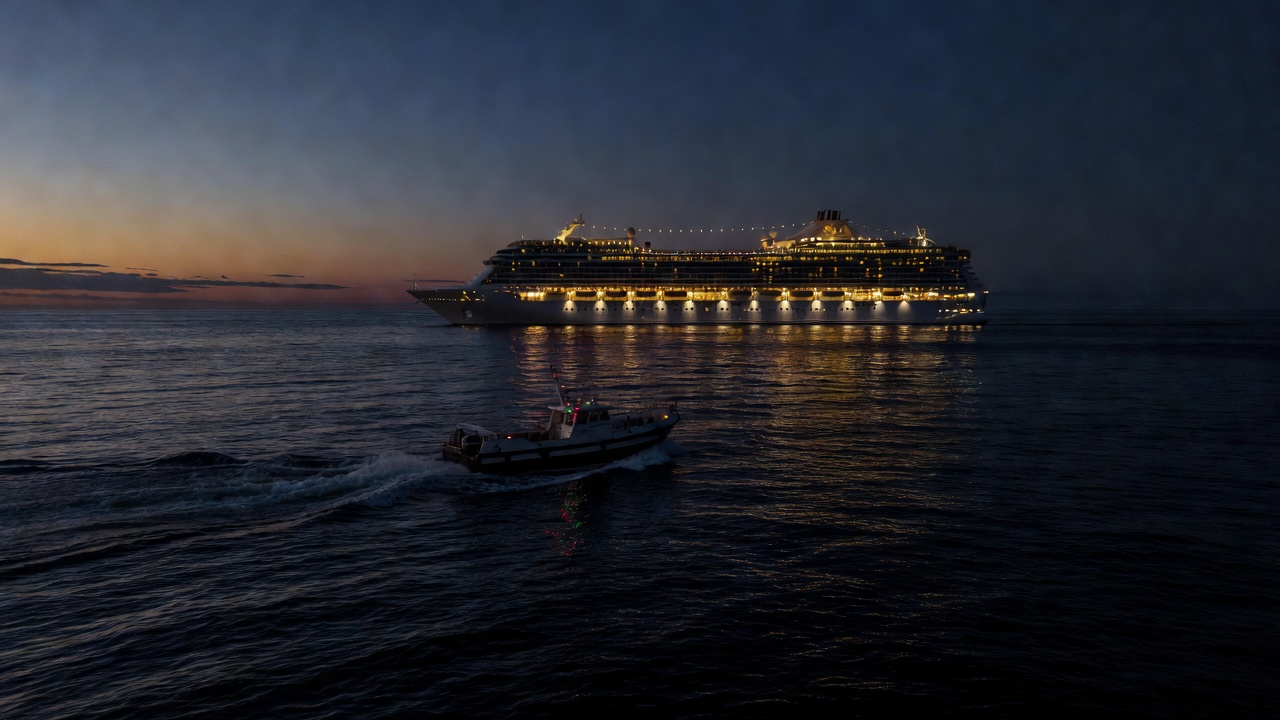
At an anchorage, the tender becomes the bottleneck. Each boat carries a fixed number of guests per run, and runs slow down as sea state rises. Organised excursions usually leave first, then independent guests. A model can sequence ticketed groups so that tour departures align with tender arrivals, and estimate the latest safe last-tender time. When a port is swapped or dropped, thousands of excursion bookings must be rebuilt or refunded, and local suppliers must be informed. This is where the cascade from the scheduling briefing becomes visible to guests.
Disembarkation and onward travel
The final morning is sequenced largely by onward travel: guests with early flights leave first, those with later connections or post-cruise stays leave later. Customs and immigration processes differ by port. In the United States, clearance is handled by Customs and Border Protection; in Schengen ports, nationality and itinerary determine which checks apply. Models can group guests by flight time and clearance needs and estimate when the terminal will be clear for the next embarkation. A delayed clearance or a late arrival changes all of these timings at once.
Onboard flow
Once aboard, flow continues: mandatory safety briefings, dining venue loads, theatre seating and lift demand on embarkation afternoon. Forecasts can suggest staggered dining times or additional show performances on a sea day. Emergency procedures and muster arrangements, however, follow the ship's safety management system and SOLAS requirements; no optimisation tool overrides them.
Privacy and fairness
Some terminals and lines use facial recognition to speed boarding. Under the EU General Data Protection Regulation, biometric data used for identification is a special category of personal data, requiring a clear legal basis, transparency and limited retention. Planners should know what data a passenger model uses, how long it is kept and whether any segmentation could disadvantage particular groups, such as guests needing assistance.
Constraint: guests needing assistance
Accessibility needs must shape the plan from the start, not be added as exceptions. Tender transfers in particular may be unsuitable for some mobility devices.
Constraint: data quality
Flight details and arrival slots are often incomplete. Forecasts built on partial data need visible margins.
Constraint: shared terminals
When several ships turn around at once, road access and coach parking become shared limits outside any single operator's control.
What stays with people
Guest services teams, port agents and security officers handle the situations forecasts miss: a missing passport, a medical disembarkation, a family separated in a queue. Decision support frees time for those cases; it does not decide them. Resource effects of passenger changes continue in Account for onboard resources.